
As a musician, it is easy to become obsessed with scales, finger placement, and perfect intonation. However, we often overlook the very engine that powers every single note: our breath. Your respiratory system is your instrument’s silent partner, and sound actually starts before the first note ever plays.
Scientific studies show that warming up and training your inspiratory muscles dramatically reduces playing fatigue and improves tone control. If you want to play with more power, endurance, and ease, you need a strategic training routine.
Here are 5 simple steps to master your airflow by training where it really counts.
5 Steps to Master Your Airflow
1. Posture First: Align Your Body
Efficient breathing starts with physical alignment. If your shoulders are rolled forward or your chest is collapsed, you are physically blocking your lungs from expanding to their full capacity.
- The Fix: Whether standing or sitting, keep your spine tall and your shoulders completely relaxed. Imagine your torso as a wide cylinder ready to receive air.
2. Inhale Deeply (360-Degree Expansion)
Many musicians default to “chest breathing,” which is shallow and triggers unnecessary tension. To sustain long phrases and stable notes, you need a low, relaxed diaphragmatic breath.
- The Fix: When you inhale, focus on expanding your lower ribs, back, and abdomen in all directions tridimensionally.
3. Release the Tension (The Enemy of Sound)
Tension is the number one killer of air velocity. If you tighten your throat or raise your shoulders when inhaling, you restrict your air passage.
- The Fix: Practice inhaling with an open, relaxed “O” shape, mimicking a gentle yawn. Your intake of air should feel completely silent and effortless, never forced.
4. Train Your Lungs Like an Athlete
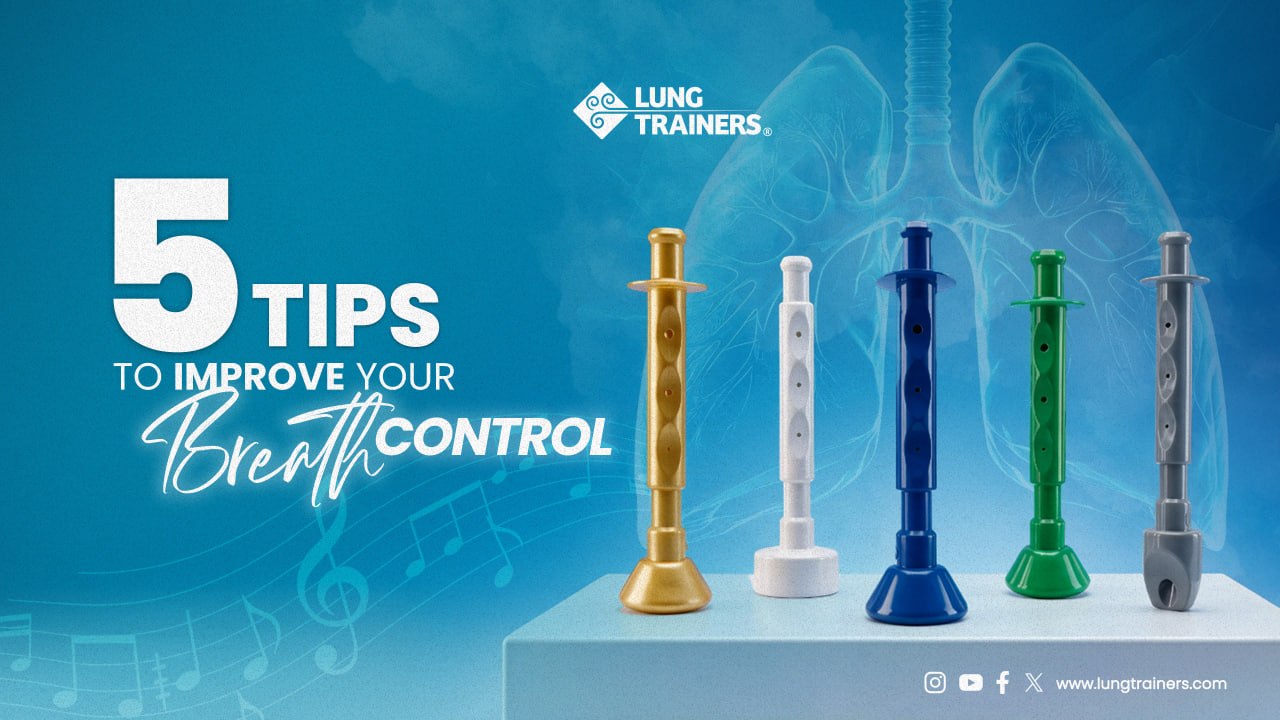
Just like runners train their lungs before a race, musicians must prepare their breath before a performance. This is where the Lung Trainer (or your IBA) becomes your ultimate training tool.
- The Benefit: Featuring a patented design with three resistance holes, it acts as a “portable gym” for your respiratory system. It forces your lungs to work actively and simulates the exact backpressure of your instrument, accelerating your training results in just minutes a day.
5. Bridge the Gap to Your Mouthpiece
The biggest challenge for wind players is transferring breathing exercises to actual playing. Traditional methods help, but they don’t mimic the sensation of having the instrument with you.
- The Benefit: The Mouthpiece Adapter on the Lung Trainer bridges this gap completely. It allows you to seamlessly connect balloon pedagogy with your actual mouthpiece. By practicing with your own mouthpiece on the device, you train your embouchure and airflow simultaneously before you even play.
The Best Way to Improve is Together
Don’t let your lungs be the weakest link in your performance. By dedicating just a few minutes a day to these five steps before your regular practice, you will quickly notice a richer tone, superior control over your dynamics, and zero fatigue.
💬 Do you have questions about setting up your training or want to share your progress?
You don’t have to do it alone! Join our Official Lung Trainers Forum to connect with band directors, marchers, and brass players from all over the world.
👉 [Click here to check out our Step-by-Step Guide and join the forum today!]