
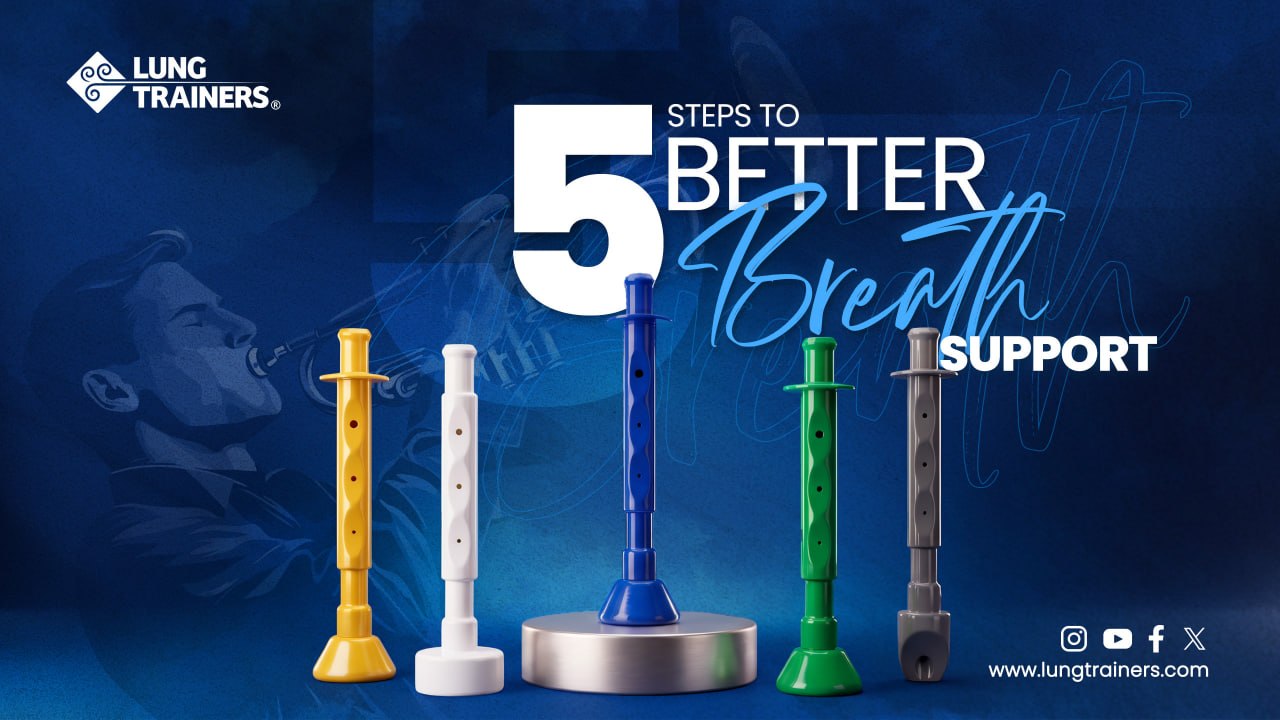
Teaching or learning proper breath support can often feel like dealing with an invisible concept. Directives like “engage your diaphragm” or “keep a steady air stream” are abstract—until you can actually see and measure your airflow in real time.
Whether you are a music educator leading a full band section or a wind player aiming to extend long phrases, building respiratory strength requires structure. The LungTrainers Incentive Breathing Assistant (IBA) transforms abstract breathing concepts into a visual, quantifiable routine.
Here is a step-by-step 5-step routine designed to strengthen your breath support, build stamina, and translate directly to your instrument.
Step 1: Establish Proper Posture and Seal
Great breath control begins before a single note is played or a single breath is taken. Alignment and mechanics set the foundation for optimal lung capacity.
- Body Alignment: Stand or sit upright with your shoulders relaxed and chest open. Avoid slouching, as it compresses the abdominal cavity and restricts full diaphragmatic expansion.
- Mouthpiece Seal: Place the LungTrainers IBA mouthpiece firmly against your lips. Ensure a complete seal without air escaping from the corners of your mouth. Proper seal forces all air through the device, ensuring accurate resistance and feedback.
Step 2: Engage Deep Diaphragmatic Inhalation
A powerful exhalation depends entirely on an efficient, full inhalation.
- Inhale with Intention: Inhale deeply through your nose or mouth without lifting your shoulders.
- Feel the Expansion: Focus on expanding your lower abdomen, sides, and lower back—allowing the diaphragm to lower and create maximum volume in the thoracic cavity.
- Avoid Tension: Keep the neck and throat relaxed to prevent restricted, shallow chest breathing.
Step 3: Activate the Air Column & Balloon Indicator
This is where the LungTrainers IBA provides instant feedback that sets it apart from traditional breathing exercises.
- Visual Feedback in Real Time: As you exhale through the device, the balloon indicator inflates only when sufficient air pressure and steady support are applied.
- Immediate Self-Correction: If you lose focus, drop your air pressure, or break your lip seal, the balloon deflates instantly. This visual cue allows you to self-correct on the spot without guessing.
Step 4: Execute the Structured Count Routine (4, 6, 8 & 12 Counts)
To build respiratory endurance, training must be structured and measurable. Music educators and students can track progress systematically through count-based challenges:
- Level 1 (Foundation): Exhale through the IBA, keeping the balloon continuously elevated for 4 counts.
- Level 2 (Building Stamina): Extend your air stream steadily for 6 and 8 counts without letting the pressure drop.
- Level 3 (Advanced Capacity): Push your endurance to 12 counts, mastering the control needed for long musical passages and demanding solos.
Step 5: Transfer the Technique Directly to Your Instrument
The ultimate goal of using the LungTrainers IBA is applying muscle memory and air efficiency to performance.
- Warm-Up Integration: Complete 3 to 5 reps of the count routine on the IBA as part of your daily warm-up or pre-rehearsal routine.
- Immediate Application: Pick up your instrument immediately after using the IBA. Replicate the exact same feeling of abdominal engagement and steady air pressure while playing your initial long tones or scale exercises.
Bring Measurable Breath Training to Your Studio
Integrating these 5 steps into your daily practice routine takes the guesswork out of breathing pedagogy. By combining visual feedback with structured count exercises, LungTrainers helps musicians build lung capacity, improve pitch stability, and play with effortlessness.
👉 Explore the LungTrainers Incentive Breathing Assistant (IBA) Here